
Buying From BDA or a Housing Board? How RERA Treats Public Promoters in Bengaluru
A guide for Bengaluru buyers considering a flat or plot sold by a development authority or housing board: why RERA treats public bodies as promoters, which rules apply differently to public projects, and what to check before booking.

A young couple in Bengaluru has shortlisted a flat in a housing scheme built by a public body. A friend tells them not to worry about RERA, because government projects are different. Their lawyer is not so sure. The question matters: if the project falls under the Real Estate (Regulation and Development) Act, 2016, the couple get the same disclosures and remedies as anyone buying from a private builder.
The Housing Ministry has answered this question directly in its FAQs on the Act. This guide sets out what those FAQs say about development authorities and housing boards as promoters, where public projects are treated differently, and what a Bengaluru buyer should check before booking a flat or plot from a public body.
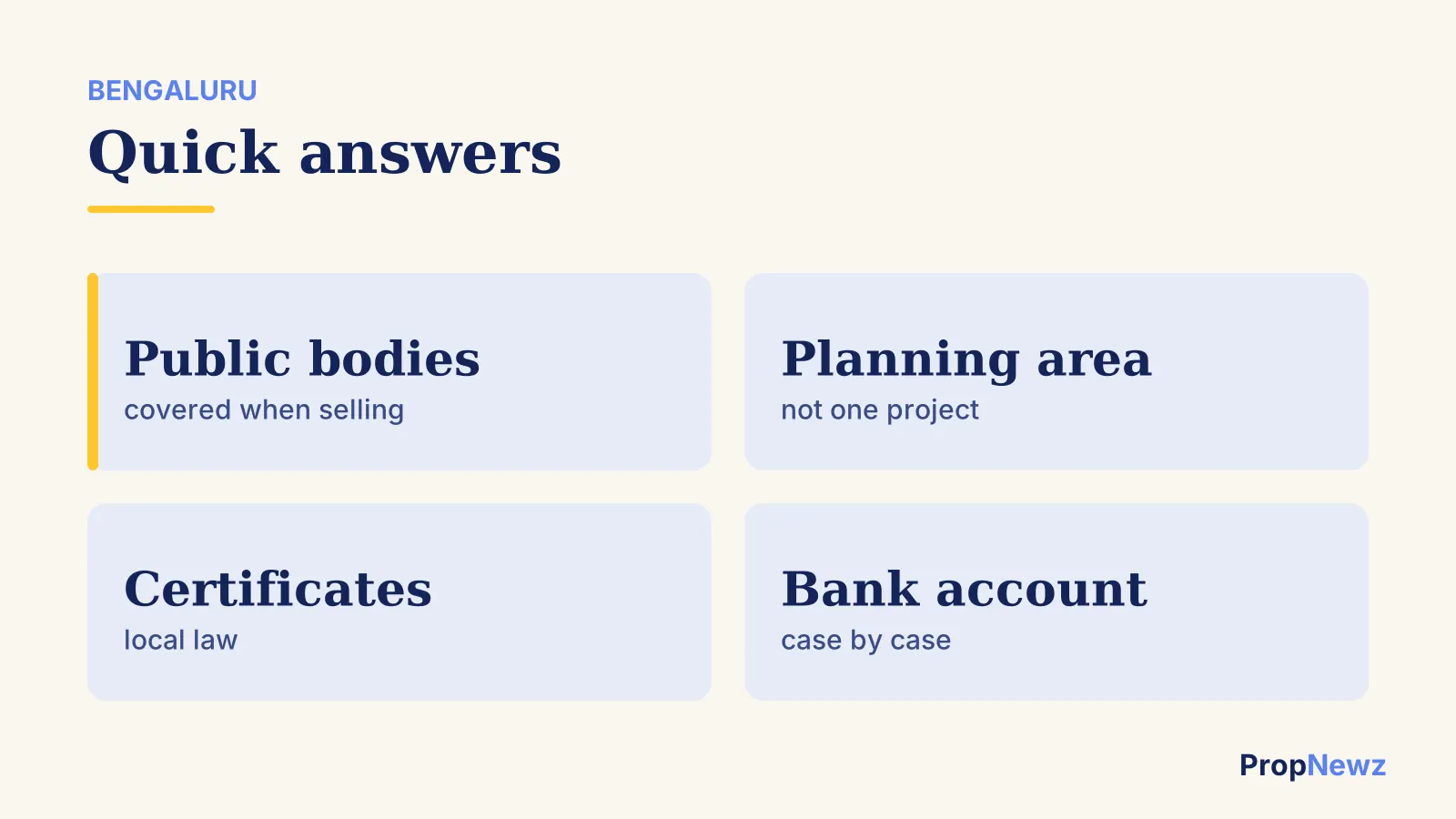
The short answer. According to the Ministry of Housing and Urban Affairs FAQs on RERA, the Act covers all bodies, private and public, which develop real estate projects for sale to the general public, and both development authorities and housing boards are covered when involved in sale. Two differences apply: such a body may issue completion and occupancy certificates for its own projects where it is also the competent authority under local law, and the regulator may exempt a self funded project from the separate bank account rule case by case. The trade-off: a public seller does not mean fewer checks, so confirm registration on the portal before you pay.
Are development authorities and housing boards promoters under RERA?
Yes, when they sell. The Housing Ministry's FAQs explain that section 2(zk) defines the term promoter to include both private and public real estate promoters. The FAQs conclude that both development authorities and housing boards, when involved in sale, are covered under the Act.
That answer turns on the word sale. The FAQs describe the Act as covering all bodies which develop real estate projects for sale to the general public. A public body that builds flats or develops plots and then sells them to buyers is acting as a promoter in the same way as a private developer, and the obligations the Act places on promoters apply to it.
For Bengaluru, this is relevant because public bodies have long been part of the city's housing supply, through development authority layouts and housing board schemes. A buyer comparing a public scheme with a private project should start from the same baseline: both sellers are promoters under the Act if they are selling a real estate project to the public.
The buyer's position follows from the same definitions. The FAQs explain that, under section 2(d), an allottee is the person to whom a plot, apartment or building has been allotted, sold or otherwise transferred by the promoter, and that it includes a person who later acquires it through transfer or sale. A buyer from a public promoter is therefore an allottee under the Act.

Does a public body have to register its whole planning area?
No. The FAQs address this point directly. They explain that section 2(zn) defines a real estate project as the development of a building or apartments, the conversion of an existing building into apartments, or the development of land into plots or apartments, for the purpose of selling all or some of them, together with the common areas, development works and related rights.
On that definition, the FAQs say the entire planning area which comes under the jurisdiction of a development authority or local body cannot be treated as a real estate project for the purpose of RERA. There may instead be multiple real estate projects within that planning area. Registration attaches to each project that is developed for sale, not to the authority's whole territory.
For a buyer, the practical point is to look for the specific scheme or layout on the regulator's portal, not for a single registration covering everything the body does. Each housing scheme or plotted layout offered for sale should, unless an exemption applies, have its own record. Our guide on BDA and BMRDA approved layouts in Bengaluru explains how layout approvals differ, which helps when you are reading a public scheme's documents.
Which RERA rules apply differently to public projects?
The FAQs identify two areas where a public body's position can differ from a private developer's. Neither removes the project from the Act. Both are narrow, and both depend on facts you can check.
The first is certificates. The FAQs explain that the completion certificate and occupancy certificate must be issued by the competent authority, as defined in sections 2(q) and 2(zf). In some cases, a development authority or urban local body may be both the promoter and the competent authority. In such cases, the FAQs say it can issue the required certificates to its own projects as per the provisions of local laws.
The second is the separate bank account. The FAQs explain that section 4(2)(l)(D) requires a promoter to keep a separate bank account for every project, into which seventy percent of the money received from allottees is deposited for construction and land cost. Where a development authority is constructing a project from its own fund and not taking any fund from buyers, the FAQs say the regulator may grant an exemption from opening that account on a case to case basis.
The table below summarises how the FAQs treat a public promoter alongside a private one. It sets out the general position; any exemption in a particular project is a matter of record with the regulator.
| Question | Private developer | Development authority or housing board selling to the public |
|---|---|---|
| Is it a promoter under section 2(zk)? | Yes | Yes, when involved in sale |
| Must the project be registered before advertising? | Yes, under section 3(1) | Yes, unless a section 3(2) exemption applies |
| Who issues the completion and occupancy certificates? | The competent authority | The body itself may, if it is also the competent authority under local law |
| Is a separate bank account required? | Yes, for every project | Yes, but the regulator may exempt a self funded project case by case |
| Is the buyer an allottee under section 2(d)? | Yes | Yes |

Why do those differences matter to a buyer?
Because each one changes what you should ask for. When the seller is also the authority that certifies completion, the certificate is still the document that marks the project as complete. It simply comes from the same body that built it. Ask which department issued it, under which local law, and what it covers, whether the whole scheme, one phase or one block.
The bank account exemption works in a similar way. The FAQs tie it to a specific situation: the authority is building from its own fund and not taking money from buyers. If a scheme collects instalments from allottees during construction, that situation does not describe it. If a public seller tells you the separate account rule does not apply, ask whether the regulator has granted an exemption for that project, and ask to see it.
The rule on when a project can be marketed does not change. The FAQs explain that a promoter can advertise a project for sale after the project has been registered with the regulator under section 3(1). The exemptions in section 3(2), which the FAQs summarise as small projects of up to 500 square metres or eight apartments inclusive of all phases, projects with a completion certificate before the Act commenced, and renovation that involves no new sales, apply to public and private projects alike.
Registration also brings disclosure. The FAQs describe how sections 4 and 11 require detailed project information on the regulator's website and quarterly updates from the promoter. A registered public scheme should therefore have a portal record you can read in the same way as a private project's.
What should a Bengaluru buyer check before booking a public scheme?
Treat a public scheme as you would any other purchase, and use the Act's framework to structure the checks. If you are weighing a public scheme against a private project such as Brigade Banashankari on our project pages, run the same steps on both. Our guide on verifying a Karnataka RERA project registration covers the portal search in detail.
- Identify the exact scheme or layout name and the public body that is selling it.
- Search the Karnataka RERA portal for that scheme and note its registration number.
- If there is no record, ask the body in writing which section 3(2) exemption it relies on.
- Read the scheme's portal page for the declared completion date, approvals and quarterly updates.
- Ask whether instalments are collected during construction and how they are held.
- If told the separate account rule does not apply, ask for the regulator's exemption order.
- At handover, check which authority issued the completion certificate and what it covers.
None of these steps assumes a public body will do anything wrong. They reflect the fact that the Act treats public and private promoters on the same footing when they sell, so the same evidence should be available. If something on the list cannot be answered, pause before paying and take legal advice.
The usual title, allotment and approval checks still apply. RERA does not replace them; it adds a public record and a regulator you can approach if the promoter does not meet its obligations.
What do Bengaluru buyers ask about public projects and RERA?
Are BDA or housing board projects covered by RERA?
The Housing Ministry's FAQs say the Act covers all bodies, private and public, which develop real estate projects for sale to the general public. They state that development authorities and housing boards, when involved in sale, are covered, because section 2(zk) defines promoter to include public promoters.
Does a development authority register its entire planning area under RERA?
No. The Housing Ministry's FAQs say the entire planning area under a development authority or local body cannot be treated as a real estate project for RERA purposes. There may be multiple real estate projects within it, and each project developed for sale is the unit for registration.
Can a development authority issue a completion certificate for its own project?
The Housing Ministry's FAQs say completion and occupancy certificates must come from the competent authority. Where a development authority or local body is both the promoter and the competent authority, it can issue the required certificates to its own projects as per the provisions of local laws.
Must a public body keep a separate RERA bank account for a project?
Generally yes. The Housing Ministry's FAQs say that where a development authority builds a project from its own fund and takes no money from buyers, the regulator may grant an exemption from the separate bank account requirement under section 4(2)(l)(D) on a case to case basis.
Last updated 2026-10-19. PropNewz Team.
Contact Us
Stay updated with latest news and new projects!
Tell us what you want, We'll do the rest.
Share your budget and where you're looking. An advisor who has actually walked the sites will shortlist a handful of RERA-registered projects and tell you which to skip.